
Going forward, when I refer to SEO & PPC, I mean Google. Other PPC search engines exist, but as of November 2025, Google commands over 92% UK market share. Calling it a market leader underplays its dominance; Google is a behemoth and a monopoly that overshadows all competitors. So, for practical purposes, references to "Google" mean the entire UK search engine market.
What's the difference between SEO and PPC?
Let’s start off with a Google search and see what we see.
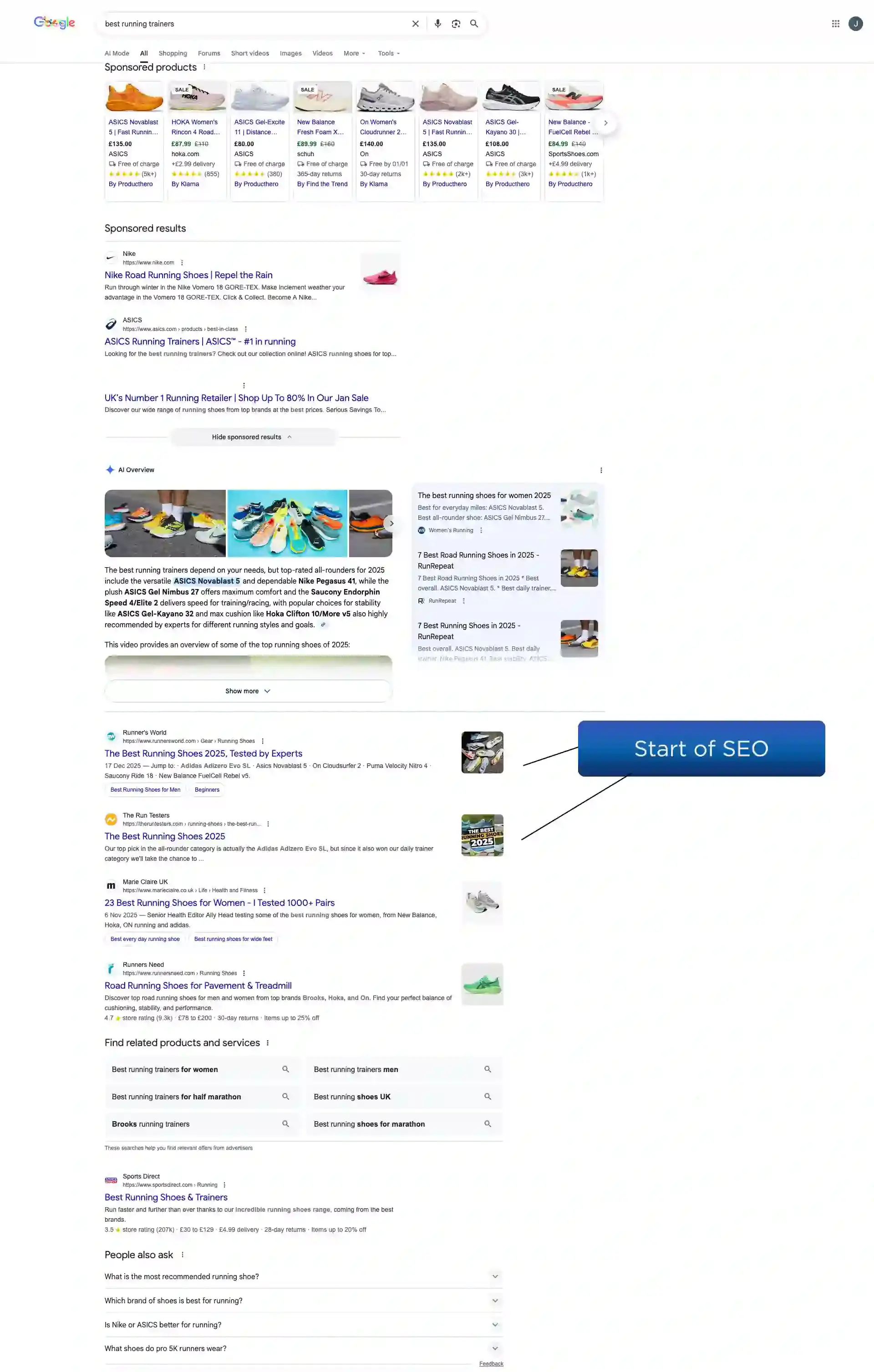
Google constantly tweaks its layout to maximise revenue.
Basically, though, in 2026, any listings you see as “Sponsored” are PPC ads.
Although SEO and PPC appear together in most Google searches, their models are fundamentally different. Even when they share the same web page, the two approaches have significant distinctions.
As you probably guessed, with PPC, you pay per click. This is all handled by Google Ads, which used to be called Google Adwords. It will probably change again. Google likes to keep renaming products, beats me why, and it can be frustrating as well as confusing millions of customers, but there's not a lot anyone can do on that front.
In the old days, it used to be that you could only bid on each keyword; now you can pick a broad topic and a daily budget and let Google do its thing. It’s astonishing what the technology can do. It uses precise and detailed profiles of Google searches and matches them to search words, all done behind the scenes.
Nowadays, many campaigns are run like this by millions of small businesses and marketing agencies, and get better results than manually adding each specific keyword and setting a maximum cost per click. You can still add manual keywords, but their whole interface and strategy seem to be moving towards this newer and more automated way of matching audience and keyword.
Setting up both methods and seeing results is a good way to start if you are serious about using PPC going forward. It’s highly likely you will find that the magic that Google works behind the scenes will outgun manual bidding.
We’d never recommend just letting it run indefinitely and unchecked, though; you will always want to monitor how things are going.
Anyways, with PPC you are paying for each click, that is certain, whilst when someone clicks on an organic listing, there is no cost. Some like to say it’s free.
When you consider the work that goes into a competitive SEO campaign, however, those organic clicks are not really free. It takes time and resources to produce content for SEO, so there is clearly a cost there when worked out long-term.
Sure, when you set up a website, and you are getting clicks for your business name, as there will be little to no competition for this term, but EVERYWHERE is getting more competitive online and certainly in search. Many brands now bid on competitors' brand names through PPC.
Let’s say you are a plumber in Tottenham, London, and your company is called The Maximmus Plumbing Company (fictitious example). It’s not unheard of for other rival plumbing companies to get their ad to show when people type in “Maximus plumbing Tottenham”. When clicking, they would go to the competition. Back in the day (I’m talking 10-15 years ), there was very little of this happening, but today in 2026, we live in very different times. Just don’t be shocked when you type in your own business name, and you see “Sponsored results” above your own organic ink.
Many businesses do, in fact, set up Google pay-per-click campaigns to capture this traffic. So when searching for their specific site and brand, they show up in sponsored results. If they didn’t set up a PPC campaign for your own brand searches, it’s likely that they will find the “Maximus plumbing company” (again - this is a fictitious example), but they may need to scroll past the sponsored listings first to then see and click.
Different Audience
It’s said that the audience that clicks on PPC ads is different from the audience that clicks on organic seo listings. We have seen evidence to suggest this, so even if it’s a campaign to target your own branded searches, it can be worth doing. Our advice: test it and see the results. You can stop and halt a PPC campaign at a moment's notice.
SEO is a long-term play
PPC campaigns deliver immediate traffic to your site within minutes, unlike SEO, which may require up to 9 months for the full impact of site changes and backlinks to be realised.
If it’s immediate results you are looking for, then PPC wins hands down.
Many new businesses choose to start off with a PPC campaign, then wind it down or completely halt the campaign when the SEO has been effective. Be warned, though: getting ranked in SEO for competitive keywords is NOT easy, and you can be looking at a 3-5 year process. Note this is for very competitive keywords and big business stuff. That's the kind of time frame and strategy required for these elite business players.
If you are a small business, your site should start showing for branded terms in the organic listings in a few weeks.
Written by John Macpherson